
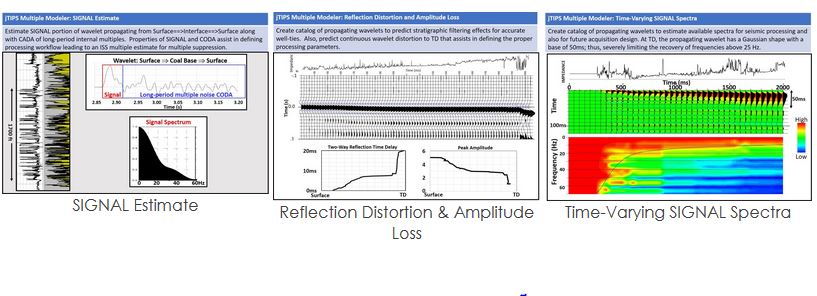
Just as the synthetic seismogram allows the interpreter to match the borehole properties to seismic, TIPS Multiple Modeler software provides the interpreter with similar tools when severe internal multiples are present. TIPS Multiple Modeler quickly quantifies the severity of the internal multiples by measuring as a function of time the properties of the short-period multiples: dispersion time delay, high-frequency loss, and attenuation. These parameters are highly desirable before data processing. In addition, the properties and time occurrence of long-period multiples are quantified for the interpreter. Basically, TIPS Multiple Modeler helps to answer, “Is that event a multiple or primary?”
When long-period multiples are suppressed in structurally flat
environments, it is difficult to evaluate the multiple-suppression
success with conventional synthetics; especially, when short-period
multiples are present. This difficulty is overcome by decomposing
generalized primaries (GP) into primary-only and multiple-only
synthetics with time-varying stratigraphic wavelets. Numerous other
interpretational benefits are available once the separation of short-
and long-period multiples is applied.
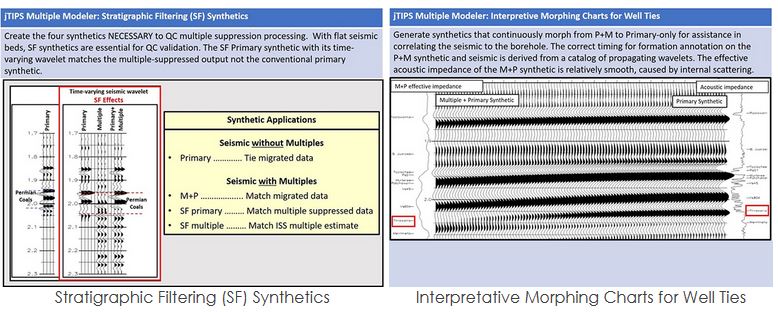
As an example, sections consisting of P+M synthetics morphing into
P-only synthetics provide a much-needed interpretative tool for well
ties with severe short-period internal multiples. These synthetics
provide the “Quantitative interpretation and validation of long- and
short-period internal multiples”.
Four synthetics provide the QC during multiple suppression processing.